
Responsible Gaming: Practical Limits, Warning Signs and Where to Get Help
Gaming should be fun. It should never harm your finances, your relationships, your health, or your peace of mind. This guide explains what responsible gaming means in everyday life, how to set a budget and time limits, how to spot the early signs of a problem, and what to do if you or someone you love needs support. It is written for adults who use the Diwa Fun Game app or any similar platform.
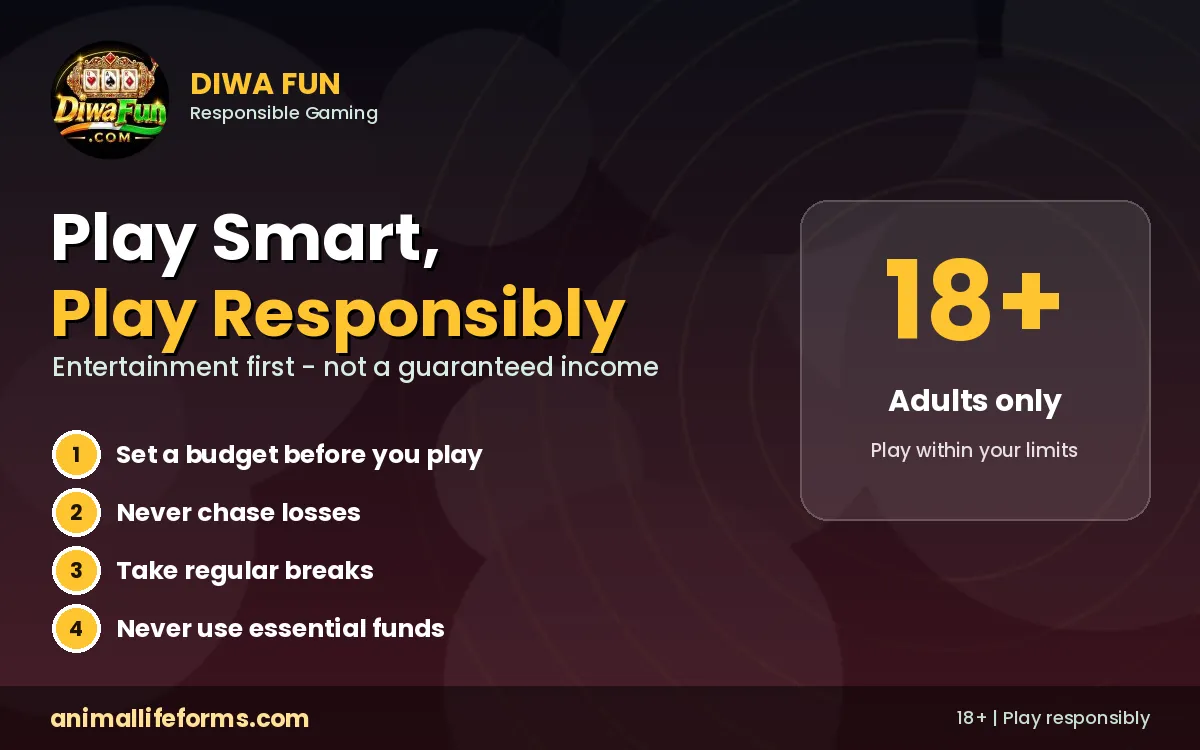
What Is Responsible Gaming?
Responsible gaming means making informed, controlled choices about when, how long, and how much you play. It starts with a simple idea: real-money gaming is a form of entertainment, not a guaranteed job or a primary investment strategy. Entertainment has a price, and a responsible player decides that price in advance and keeps to it.
It also means understanding how the games work. Slots, card games, color prediction, crash-style rounds, and lottery draws involve a large amount of chance. Even skill-based formats cannot remove risk. Platforms often say that they use audited random number generation to keep outcomes fair, but fairness does not mean that you will win. Fair games can still produce long losing streaks, and the house advantage means that, over time, the average player loses money.
The Golden Rules of Safe Play
- Play within your means: Treat real-money gaming as entertainment, not a guaranteed job or primary investment strategy.
- Set strict budgets: Establish clear daily deposit limits and never play with funds meant for essential living expenses.
- Maintain control: Avoid chasing losses under stress. Take regular breaks to keep your gaming fun and balanced.
- Never borrow to play: Do not use loans, credit, or money that belongs to someone else.
- Stay sober and calm: Do not play when you are angry, sad, tired, or under pressure.
- Stay adult-only: Only people aged 18 or older should play, and children must never have access to your account or wallet.
How to Set a Budget That Works
A budget is the single most effective protection you have. The best time to create it is before you open the app, when your mind is clear. Follow these steps to make one that you can actually keep.
- Calculate your free money: Take your monthly income, subtract rent, food, transport, bills, savings, and family support. What is left over is the only money that can ever be considered for entertainment.
- Choose a small part of it: Decide on a weekly amount that would not hurt if it disappeared completely.
- Write it down: Put the number in a note on your phone so that you can see it.
- Deposit only that amount: Do not top up again during the same week, even if you lose quickly.
- Treat winnings as separate: Withdraw part of any win so that it returns to your normal life instead of going straight back into the game.
- Review every month: Look at your total spending and ask honestly whether it was worth it.
Starting with the smallest deposit keeps early risk low while you learn how the games and the wallet work.
Time Limits and Healthy Breaks
Money is not the only thing that can slip away. Time disappears quickly in fast games, where a round lasts under a minute and the next one begins immediately. Decide beforehand how long you will play, set an alarm on your phone, and stop when it rings. Short sessions are healthier and give you a clearer head for decisions.
- Take a five to ten minute break every half hour.
- Avoid gaming late at night, when tiredness weakens judgment.
- Do not play during work, study, prayer, family meals, or time with children.
- Keep other hobbies alive, such as sports, reading, or time with friends.
- Log out after each session instead of staying signed in all day.
Warning Signs of a Gaming Problem
Problems rarely appear overnight. They usually grow slowly, and the person involved is often the last to notice. Learn to recognize the early signs in yourself and in people close to you.
| AREA | WARNING SIGNS |
|---|---|
| Money | Spending more than planned, borrowing to play, selling belongings, or missing bill payments. |
| Behavior | Chasing losses, increasing stakes after a loss, or playing to escape stress. |
| Time | Playing for hours, neglecting work, study, or family duties. |
| Emotions | Irritability, anxiety, guilt, or a sense of emptiness when not playing. |
| Secrecy | Hiding the app, lying about spending, or deleting transaction messages. |
| Relationships | Arguments at home, withdrawal from friends, or loss of trust. |
If several of these sound familiar, treat it as a signal to pause and take action, not as a reason for shame.
Why Chasing Losses Is Dangerous
Almost everyone feels the urge to win back what they just lost. It feels logical: one good round might fix everything. In reality, every round is independent, and nothing in the game owes you a win. Increasing your stakes after a loss usually produces bigger losses, faster. The healthier choice is to stop at your limit, leave the app, and return another day, if at all.
If you notice that you are making payments in a hurry, deposit after deposit, you are likely chasing. Close the app, put the phone down, and do something different for at least an hour. The urge fades surprisingly fast once you step away.
Tools and Habits That Protect You
- Use the limits offered in the app: If deposit or time tools are available, switch them on.
- Use biometric login and 2FA: They keep other people, including children, from opening your account.
- Keep your wallet PIN private: Never share it, even with friends.
- Use only your own wallet: Deposits and withdrawals should always go through your own EasyPaisa or JazzCash number.
- Turn off notifications: Promotional alerts can tempt you to log in when you had planned to rest.
- Track every deposit and result: A simple note shows the real picture of your activity.
- Do not let bonuses drive spending: Rewards are small extras and not a reason to deposit more. See the bonus guide for the rules.
Protecting Your Family and Children
Phones are shared in many homes, and children are curious. Keep your gaming apps behind a lock screen, do not leave your phone logged in, and never share your wallet PIN or OTP codes where a child can see them. Use parental controls to block installation of unknown apps. If you suspect that a young person has used a gaming app, talk calmly, check wallet messages together, and contact the platform’s support to close the account. Minors must never gamble for money.
If You Think You Have a Problem
Recognizing a problem is not a failure. It is the first step toward getting control back. If you feel that gaming is taking over, consider the following actions, one at a time.
- Stop depositing today: Decide that no new money goes into the app for now.
- Take a long break: Log out and, if it helps, delete the app from your phone.
- Tell someone you trust: A friend, a relative, or an elder in the family can offer support and accountability.
- Write down your debts and spending: A clear picture reduces fear and helps you plan.
- Remove temptations: Mute gaming groups, unfollow promotional pages, and delete saved links.
- Seek professional help: A doctor, counselor, or mental health professional can offer guidance suited to your situation.
If you feel hopeless or you are thinking of harming yourself, contact a trusted person or your local emergency or crisis service straight away. You are not alone, and help is available.
Helping a Friend or Family Member
Seeing someone you care about struggle with gaming is painful. Approach them with kindness instead of anger. Choose a calm moment, explain what you have noticed, and focus on your concern rather than blame. Offer to help them make a plan, review their spending, or find a counselor. Do not lend money to cover gaming debts, because it often prolongs the problem. Protect your own finances and wellbeing, and remember that recovery takes time and patience.
Legal Awareness and Adult-Only Play
Online real-money gaming can be restricted or unclear under the rules of some countries and regions. Responsible players take the time to learn what applies to them and respect it. If gaming is not permitted where you are, do not take part. Please read our disclaimer for more information about risks, legal responsibility, and the limits of our content. You can learn more about our approach on the About Us page, and you may reach us through the contact page if you have questions.
Frequently Asked Questions
1. Can gaming be a source of regular income?
No. Outcomes depend heavily on chance and most players lose money over time. It should be treated as entertainment.
2. How much should I deposit?
Only an amount you can afford to lose completely, taken from money left after essential expenses, starting as small as possible.
3. What should I do after a big loss?
Stop, log out, and take a break. Do not deposit again to win it back.
4. How do I know if I am losing control?
Warning signs include spending more than planned, borrowing, hiding your play, and feeling anxious when you are not playing.
5. Who should never play?
Anyone under 18, anyone for whom gaming is not allowed by law, and anyone who cannot afford to lose money.